Behind the GDIN Innovation Fund 2026
Since 2018, the Good Death Impact Network has worked quietly, connecting changemakers across Australia's end-of-life sector. From 2020-2025 we trialled an Innovation Fund to support early stage ideas in the space. This year, with the GDIN Innovation Fund 2026, we tried something new: we opened our doors.
Why open the Fund publicly
Every round before this one stayed within our existing network. This time, we wanted to reach more people across Australia with ideas for improving experiences of death, dying and grief – particularly community-led ideas that may sit outside established funding pathways. We thought opening the Fund in this way would broaden and strengthen the network, create new connections and increase our collective capacity to scale our impact. We also wanted to bring more perspectives and possibilities into a shared field of action aligned with GDIN’s systems change levers.
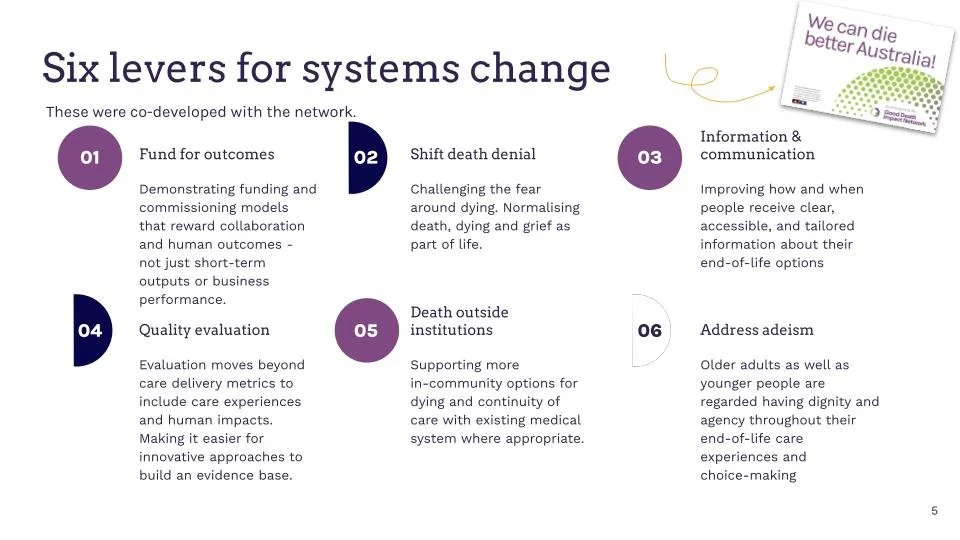
Image: A snapshot of GDIN’s Systems Change Levers
The response was 72 applications. That's more than we've ever received, and it came from a far wider range of people than our usual network: community radio hosts, prison abolitionists, aged care workers, doulas, siblings, playwrights, students, and people simply carrying an idea they'd never had the support or opportunity to develop.
“It did give me more insight into how to consider relative potential benefits of the projects applying for grants. I love that in this process there is such generosity in giving, and grace in receiving, feedback. [The process] increased my respect for the cohesive ‘greater good’ motivation of all participants. Be prepared to be challenged and to be held to account for your decisions re the grant allocations. This process is totally transparent.”
– Jan McGregor, GDIN Member & Innovation Fund Applicant
A first for our Stewards, too
This round also marked the first time our Stewards were involved throughout the process, from shaping the prioritisation approach to recommending funding decisions. It's a small but meaningful step toward the kind of member-driven, transparent granting process our members have told us matters most – one where the network itself has a hand in deciding what gets backed.
This is also one way we are putting our first systems change lever – Fund for Outcomes – into practice: directing funding towards shared human outcomes, while creating space for collaboration, feedback and learning. Running a round at this scale, with this many applications, tested our systems in ways smaller rounds hadn't. What we learned will directly shape how we design the next Fund and potentially shape how others in the sector could consider funding too
Two tiers, one intention
We deliberately structured the Fund into two tiers to support community-led ideas at different stages:
Microgrants ($750) for early-stage, exploratory ideas — the kind that need a small amount of support to take a first real step. Twelve of these were funded, including a death-literacy curriculum review in Queensland schools, an immersive theatre piece exploring Voluntary Assisted Dying, and a peer support pilot for bereaved siblings.
Small grants (up to $5,000) for more developed projects ready to test, pilot or evaluate. Twelve were funded here too, spanning a realist evaluation across four community hospices, a lived-experience zine on dying in prison, and an early feasibility study into a co-operative model for deathcare.
Between them, the two tiers distributed $50,000.
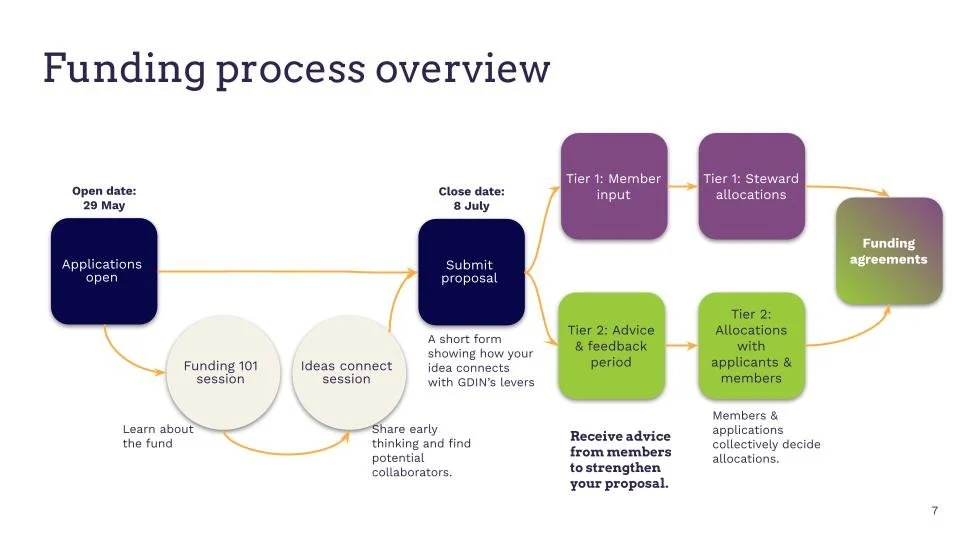
Image: Participatory grantmaking funding process overview
What the projects tell us
Across all 24 projects, and patterns from our Six Levers for Action start to surface. Several projects work to shift death denial, bringing dying into community settings and everyday conversation, from a Perth library series to a Shoalhaven radio show.
Others focus on information and communication, building resources tailored to CALD communities or exploring what schools currently teach. A few take direct aim at death outside institutions, like the community hospice evaluation and the deathcare co-operative analysis, while others build the evidence needed for quality evaluation. And more than one project challenges who is seen as entitled to a good death at all, tackling ageism and most powerfully the zine giving voice to death and dying inside the prison system.
The patterns tell us something about where the energy for change in this sector sits and how many diverse actions, aligned around shared systems levers, can begin to shift the conditions that keep problems in place.
“My experience with participatory grantmaking through GDIN gives me hope that we really do have the ability to transcend self-interest and serve the greater good. I wish every funder that is truly interested in fostering collegiality, collaboration and cooperation in the community sector could come to understand the potential of participatory grant-making.”
– Joe Sehee, GDIN Member & Steward
What happens next
Funded projects begin their work progressively from now, with most running within the next year, though we've deliberately kept timelines flexible, because good community-led and innovative ideas don't always move on a fixed schedule. We'll share what we learn as projects unfold, the same way we always have: openly, and alongside the network.
If this round showed us anything, it's that the appetite for change in how Australians experience death, dying and grief is bigger than our network alone. Our job now is to keep making space for it and partnering with others funding and supporting this work to grow our impact together.
See the full list of funded projects
Are you interested in partnering with GDIN to help more ideas get funded? Get in touch at contact@gdin.com.au
Interested in learning more about this way of grantmaking with community? Check out TACSI’s Participatory Grantmaking in Practice Paper.